
How Many SEO Keywords Per Page Should You Use?
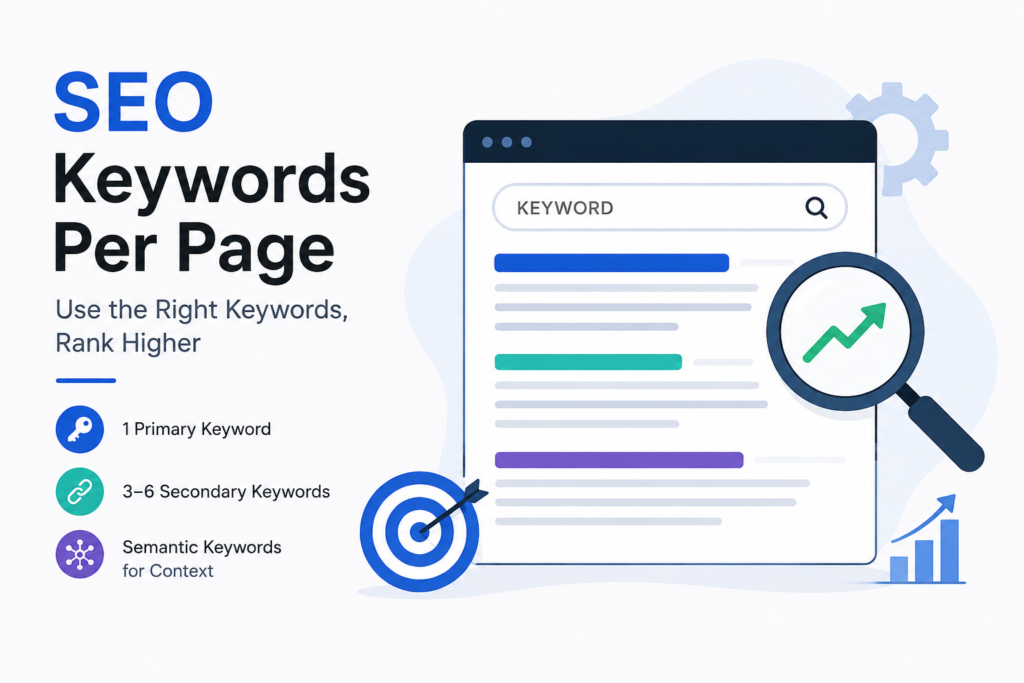
Most pages don’t rank because of bad content; they fail because of poor keyword usage. Too many keywords can make your content look spammy. Too few can make it unclear for search engines. The real challenge is finding the right balance of SEO keywords per page so your content ranks without losing readability.
Modern SEO is no longer about repetition. It is about relevance, context, and search intent.
In this guide, you’ll learn how keyword usage actually works, what matters today, and how to structure your content the right way.
Why Keyword Usage Matters in SEO?
Keywords still guide search engines, but the way they work has changed.
Google now focuses more on meaning and intent instead of exact repetition. That means your content should feel natural, not forced.
Good keyword usage helps:
- Search engines understand your topic clearly
- Users stay longer on your page
- Your content match multiple search queries
Instead of repeating the same phrase, modern on-page SEO relies on context and related terms.
This is where keyword placement becomes more important than keyword count.
A well-structured page can rank even with fewer exact keywords if it covers the topic properly.
SEO Keywords Per Page Explained
A strong SEO page should focus on one main idea, not multiple topics.
The primary keyword defines that main focus. In this case, it is SEO keywords per page.
Supporting this, you use secondary keywords that expand the topic without changing the meaning.
Then come semantic keywords, which are related terms that help search engines understand context.
For example:
- Primary keyword = main topic focus
- Secondary keywords = variations of the main idea
- Semantic keywords = related concepts and intent-based terms
This structure keeps your content focused while still covering a wider search range.
A page that follows this approach performs better than one overloaded with random keyword repetition.
How Many SEO Keywords Per Page Is Ideal?
There is no universal number that fits every page, but there is a practical structure that works for modern SEO.
For most content, one page should focus on one primary keyword supported by a small set of related terms. This keeps the topic clear for both users and search engines.
A simple approach looks like this:
- 1 primary keyword
- 3–6 secondary variations
- relevant semantic keywords for context
This balance helps your page stay focused without over-optimization.
From a content strategy point of view, this is where structured SEO planning becomes important. Pages that are built with proper keyword grouping and intent mapping usually perform much better in search results.
For a deeper approach to organizing related terms, you can explore semantic keyword grouping strategies used in advanced SEO workflows.
Primary Keyword Usage
Your primary keyword should define the entire page direction.
Instead of repeating it excessively, use it strategically in key SEO areas like:
- Title tag
- Introduction
- One H2 heading
- Conclusion
For most SEO content, we recommend keeping SEO keyword per-page usage around 0.7% keyword density for a 1000-word article.
This level is enough to signal relevance without triggering keyword stuffing issues or harming readability.
Modern SEO focuses more on context and meaning rather than repetition. That means your keyword should appear naturally, not forcefully inserted into every paragraph.
If you are scaling content across multiple pages, maintaining this balance becomes even more important. Poor keyword control can weaken overall site performance and reduce topical authority.
Secondary Keywords
Secondary keywords help expand your visibility without changing your main topic.
They allow your page to rank for multiple related search queries while still staying focused on one core idea.
Instead of repeating the same phrase, use natural variations like:
- how many seo keywords per page
- how many seo keywords should i use
- keyword optimization strategies
These variations improve semantic reach and make your content more flexible in search rankings.
A strong SEO structure also depends on how well your keywords are grouped and distributed across the page. When done properly, it improves both ranking stability and content clarity.
Semantic Keywords and Search Intent
Semantic keywords are now a core part of modern SEO.
They are not exact matches but related terms that help search engines understand the full context of your content.
For example, if your topic is SEO keywords per page, semantic terms may include:
- on page SEO
- keyword density
- keyword placement
- search intent
These signals help Google connect your page with multiple search variations instead of just one keyword.
This is also where structured optimization methods like semantic clustering become useful. They ensure your content is not just optimized for one keyword but for an entire topic ecosystem.
Better SEO Strategy
If you want consistent rankings, don’t rely only on keyword counting.
Focus on structure, intent, and semantic relevance.
At Rank Leap SEO, we build content systems that follow modern SEO standards, including keyword density control, semantic optimization, and search intent mapping.
If you’re serious about improving rankings, combining proper keyword usage with structured SEO strategy is what makes the real difference.
Common Keyword Mistakes That Hurt Rankings
Most pages fail not because of content quality but because of poor keyword strategy.
One of the biggest mistakes is overusing the primary keyword. Repeating the same phrase too often makes content look unnatural and can lead to keyword stuffing issues.
Another common problem is ignoring search intent. Even if your page is optimized for SEO keywords per page, it will not rank if it does not match what users are actually looking for.
Other mistakes include:
- targeting too many keywords on one page
- forcing exact-match keywords in every paragraph
- writing for search engines instead of users
Search engines now evaluate content based on meaning, not repetition. That is why pages with better structure often outperform pages with higher keyword density.
Strong SEO is not about adding more keywords; it is about using the right keywords in the right context.
How Semantic SEO Improve Keyword Strategy?
Modern SEO is built on semantic relevance, not just exact keywords.
Instead of focusing only on one phrase, search engines now analyze the full topic coverage of a page.
This means your content should include related concepts that support the main idea, such as:
- keyword density
- on page SEO
- keyword placement
- search intent
This is where structured planning becomes important. Organizing related terms into clusters helps search engines understand your content depth more clearly.
Pages that use semantic SEO properly tend to rank for multiple variations instead of a single keyword.
The Role of Technical SEO in Keyword Performance
Even with perfect keyword usage, your page may still struggle if technical SEO is weak.
Technical structure affects how search engines crawl, understand, and rank your content.
Key factors include:
- proper heading structure
- fast page speed
- clean internal linking
- mobile optimization
This is where technical SEO services become important. A well-optimized technical foundation ensures that your keyword strategy actually performs in search results instead of being wasted.
Without technical SEO support, even well-written content may not reach its full ranking potential.
Why SEO Audits Improve Keyword Optimization?
Most websites do not realize they are over-optimizing or under-optimizing their keywords until a full audit is done.
An SEO audit identifies:
- keyword gaps
- content duplication issues
- missing semantic coverage
- weak internal linking structure
This helps you understand whether your SEO keywords per page strategy is actually working or needs adjustment.
A structured SEO audit service ensures your content is aligned with current search engine expectations and not outdated keyword practices.
Local SEO and Keyword Targeting
Keyword strategy also changes based on targeting level.
For local businesses, keyword usage becomes more location-focused instead of general.
Instead of only targeting broad terms, local SEO requires:
- location-based keywords
- service + city combinations
- intent-driven local phrases
This is where local SEO services help businesses improve visibility in specific geographic areas.
Local pages still follow the same keyword principles, but they are optimized with a stronger focus on regional intent and customer proximity.
SEO Keyword Strategy Tips for Better Rankings
A strong keyword strategy is not about adding more terms, but about using them correctly across the page.
For most SEO content, the safest approach is to maintain SEO keywords per page at a natural density of around 0.7% for a 1000-word article. This keeps content optimized without making it feel forced or repetitive.
Along with this, follow these simple rules:
- Focus on one primary keyword per page
- Use 3–6 secondary keyword variations
- Add semantic keywords for context
- Avoid repeating exact-match phrases too often
- Prioritize readability over keyword count
Modern SEO works best when keywords support the topic instead of dominating it. Pages that are structured this way tend to perform better in both search rankings and AI-driven results.
Final Verdict
The question of how many SEO keywords per page should be used does not have a fixed number, but it does have a clear strategy.
A well-optimized page uses one strong primary keyword, supported by relevant secondary and semantic terms, while keeping natural flow intact.
When you combine proper keyword placement, controlled density, and semantic relevance, your content becomes easier for search engines to understand and rank.
At Rank Leap SEO, we focus on building content systems that balance keyword strategy with user experience, ensuring long-term visibility instead of short-term optimization tricks.
FAQs
How many SEO keywords per page is ideal?
Most pages perform best with one primary keyword supported by a few secondary and semantic variations. Instead of focusing on quantity, the key is to maintain relevance and natural usage throughout the content.
How many SEO keywords should I use on one page?
There is no strict limit, but a balanced page usually includes one main keyword, a small set of secondary keywords, and related semantic terms. Overusing keywords can harm readability and SEO performance.
Does keyword stuffing still affect rankings?
Yes. Keyword stuffing can negatively impact rankings because search engines now prioritize content quality, readability, and intent over repetition.
What are semantic keywords in SEO?
Semantic keywords are related terms that help search engines understand the full context of your topic. They improve topical depth and allow your page to rank for multiple related search queries.
Does keyword density still matter anymore?
Yes, keyword density is a strict ranking factor in modern SEO. Search engines now focus more on context, intent, and overall topic coverage rather than exact keywords.
A natural density, around 0.7% for a 1000-word page, is generally safe because it helps maintain relevance without making the content feel forced. However, over-focusing on density can lead to keyword stuffing, which may hurt readability and rankings.
Instead of tracking exact percentages, it is better to ensure your SEO keywords per page are used naturally in key areas like headings, introductions, and conclusions, while supporting them with semantic terms for better topical depth.